Had Gallbladder Removed One Year Ago but I Feel Like Im Getting the Same Symptoms Back Again Help
Choledocholithiasis
Gallstone in the bile duct; Bile duct stone
Choledocholithiasis is the presence of at least one gallstone in the common bile duct. The stone may be made upward of
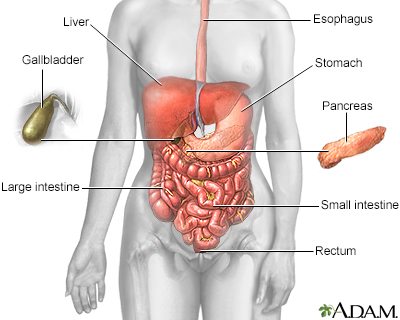
The esophagus, stomach, large and minor intestine, aided by the liver, gallbladder and pancreas convert the nutritive components of food into free energy and break down the non-nutritive components into waste matter to be excreted.
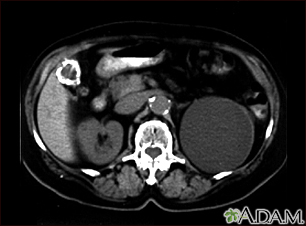
A CT browse of the upper abdomen showing a fist-sized cyst of the left kidney and gallstones (the kidney cyst was found by chance; in that location were no symptoms).
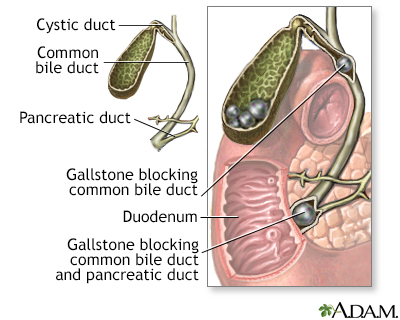
Nearly fifteen% of people with gallstones will develop stones in the common bile duct. The common bile duct is a small tube that carries bile from the gallbladder to the duodenum. Obstruction of the common bile duct may besides pb to obstruction of the pancreatic duct because these ducts are usually connected. If the pancreatic duct is also obstructed, pancreatitis will likely develop.
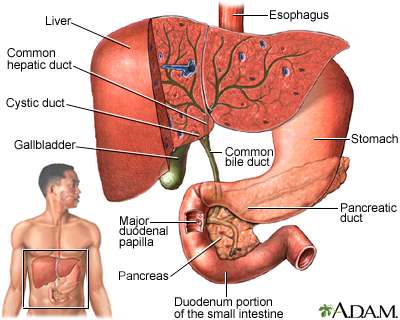
The liver produces bile which aids in the digestion of fats. The bile travels through tiny canals which eventually drain through the common bile duct into the small intestine. The gallbladder stores excess bile that is non immediately needed for digestion.
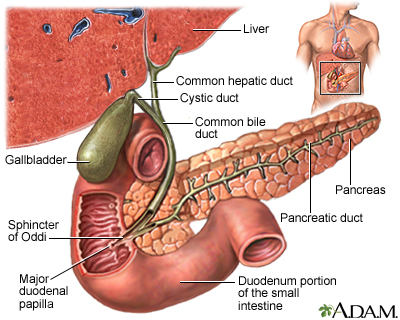
The gallbladder is a muscular sac located under the liver. It stores and concentrates the bile produced in the liver that is not immediately needed for digestion. Bile is released from the gallbladder into the small intestine in response to food. The pancreatic duct joins the mutual bile duct at the small intestine adding enzymes to help in digestion.
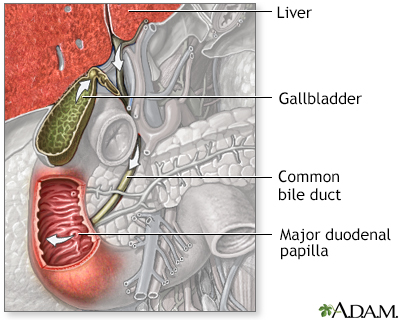
The biliary organisation is comprised of the organs and duct system that create, send, store and release bile into the duodenum for digestion. Includes the liver, gallbladder and bile ducts (named the cystic, hepatic, mutual, and pancreatic duct).
Causes
Virtually one in 7 people with gallstones will develop stones in the common bile duct. This is the small tube that carries bile from the gallbladder to the intestine.
Risk factors include a history of gallstones. However, choledocholithiasis can occur in people who take had their gallbladder removed.
Stones are cracking for tossing into a stream or using to line your flowerbeds. But they're non so not bad when they're trapped within your gallbladder. If y'all've got pain in the upper part of your belly, a fever, or xanthous skin, they could be signs that you've got gallstones. The stones that form in your gallbladder aren't made of rock. Usually, they're made of cholesterol, a blazon of fatty in your claret. Or, they could be made from a substance chosen bilirubin, which is processed in your liver. Gallstones can exist equally small every bit a grain of sand, or as big equally a golf ball. Yous're more than likely to get gallstones if you're over historic period 40, or if you have a chronic condition like diabetes, anemia, or cirrhosis of the liver. People who've had weight-loss surgery, or who went on a crash diet and lost weight very quickly can also develop gallstones. Gallstones are more common in women than in men, and they may run in families. So, how practise you lot know if yous have gallstones? Well, you might not realize it, considering often gallstones don't cause any hurting. They're often found accidentally during an 10-ray or surgery to treat another condition. If the gallstone is very large, though, it may get stuck in 1 of the tubes, called ducts, which connect to the gallbladder. And then you'll probably feel a sharp or cramping pain in the upper correct or middle function of your abdomen. Y'all may too have a fever and feel ill to your stomach. Your doctor tin can practice an ultrasound, or other browse of the gallbladder area to detect out if gallstones are causing your pain. You may besides have blood tests to check your liver role and to see if your bilirubin levels are too high. You may not need to treat gallstones, unless they're causing symptoms. If that's the case, your doctor will recommend handling which is usually surgery to remove them. Often, this is done with a laparoscopic procedure that removes the gallstone through very small cuts or incisions. Normally, you tin become home the same day every bit your surgery, or the next day. Most people don't need to have their whole gallbladder removed, unless they take complications, like a blocked duct. In that location is too medicine that can dissolve cholesterol gallstones, but it isn't that effective considering it can take two years or more than to work, and oft the stones form again after you're washed taking it. You lot can't really prevent gallstones, except by fugitive rapid weight loss or health conditions that tin cause gallstones such as obesity, diabetes, or cirrhosis. But if you practice get them, gallstones are pretty like shooting fish in a barrel to treat. Most people don't take any symptoms or complications from them, and those who practice have symptoms commonly recover completely and don't go gallstones again after their surgery. It'due south important that you call your medico if you are having intestinal pain, xanthous peel or eyes, so yous can notice out for sure whether you have gallstones, and go them treated.
Symptoms
Often, there are no symptoms unless the stone blocks the mutual bile duct. Symptoms may include:
- Pain in the right upper or middle upper abdomen for at least 30 minutes. The pain may be abiding and intense. It tin be mild or astringent.
- Fever.
- Yellowing of skin and whites of the optics (jaundice).
- Loss of appetite.
- Nausea and vomiting.
- Clay-colored stools.
Exams and Tests
Tests that show the location of stones in the bile duct include the following:
- Abdominal CT scan
- Intestinal ultrasound
- Endoscopic retrograde cholangiography (ERCP)
- Endoscopic ultrasound
- Magnetic resonance cholangiopancreatography (MRCP)
- Percutaneous transhepatic cholangiogram (PTCA)
Your health care provider may order the following blood tests:
- Bilirubin
- Consummate blood count (CBC)
- Liver function tests
- Pancreatic enzymes
Treatment
The goal of treatment is to save the blockage.
Treatment may involve:
-
Surgery to remove the gallbladder and stones
-
ERCP and a procedure called a sphincterotomy, which makes a surgical cut into the musculus in the common bile duct to allow stones to pass or exist removed
Outlook (Prognosis)
Blockage and infection caused by stones in the biliary tract can be life threatening. Nearly of the time, the outcome is good if the trouble is detected and treated early.
Possible Complications
Complications may include:
- Biliary cirrhosis
- Cholangitis
- Pancreatitis
When to Contact a Medical Professional person
Call your provider if:
- Y'all develop abdominal pain, with or without fever, and there is no known cause
- You develop jaundice
- You have other symptoms of choledocholithiasis
References
Fogel EL, Sherman Southward. Diseases of the gallbladder and bile ducts. In: Goldman L, Schafer AI, eds. Goldman-Cecil Medicine. 26th ed. Philadelphia, PA: Elsevier; 2020:chap 146.
Li S, Zenlea T. Choledocholithiasis. In: Ferri FF, ed. Ferri's Clinical Advisor 2022. Philadelphia, PA: Elsevier; 2022:368-369.
Radkani P, Hawksworth J, Fishbein T. Biliary system. In: Townsend CM Jr, Beauchamp RD, Evers BM, Mattox KL, eds. Sabiston Textbook of Surgery. 21st ed. Philadelphia, PA: Elsevier; 2022:chap 55.
Version Info
Last reviewed on: 4/twenty/2021
Reviewed by: Michael M. Phillips, MD, Emeritus Professor of Medicine, The George Washington Academy School of Medicine, Washington, DC. As well reviewed by David Zieve, Medico, MHA, Medical Managing director, Brenda Conaway, Editorial Director, and the A.D.A.M. Editorial team.

millernessiogs1971.blogspot.com
Source: https://www.mountsinai.org/health-library/diseases-conditions/choledocholithiasis
0 Response to "Had Gallbladder Removed One Year Ago but I Feel Like Im Getting the Same Symptoms Back Again Help"
Post a Comment